


Looking at this photograph of myself today, I see a reflection of authenticity and a journey of profound self-discovery. Yet, if you had shown this very image to my middle school or high school self, my immediate instinct would have been to meticulously edit it in Photoshop, erasing every single freckle until my complexion appeared flawlessly uniform. This visceral reaction stemmed from a deeply ingrained belief that freckles were synonymous with imperfection, a visible flaw on an otherwise desirable canvas.
Embracing Authenticity: My Journey to Freckle Acceptance and Self-Love
For many years, my world was colored by an aspiration for the ‘perfect’ complexion – one that was entirely unblemished, free from the subtle constellations that dotted my skin. This relentless pursuit of an idealized image profoundly impacted my self-perception, leading to a significant struggle with my body image. I dreaded looking at photographs, scrutinizing my reflection with a harshness I wouldn’t wish upon anyone. The sight of my own face often evoked a profound sense of dissatisfaction, fuelling a quiet, personal battle against my natural appearance and contributing to low self-esteem.
My family, well-meaning though they were, inadvertently reinforced these insecurities. Frequent comments about my freckles – how dark they became after sun exposure, or the curious assertion that I had them because I didn’t eat all my rice (a charming, albeit impactful, old Chinese wives’ tale) – added layers to my complex feelings. It wasn’t just the freckles; I also harbored a strong dislike for two moles on my face, one on my cheek and another on my chin. These, too, became subjects of family remarks, playfully suggesting the one on my cheek was from crying too much, and the one on my chin from eating too much. While these comments were delivered with affection and humor, their cumulative effect was anything but lighthearted, subtly eroding my confidence.
Each time I saw a photograph of myself, my gaze would fixate on these perceived imperfections. I’d instinctively cover my mole, a silent whisper in my mind affirming, “I would be so much prettier without that.” This persistent self-critique chipped away at my self-worth, solidifying the notion that my natural features were hindrances to true beauty. The desire to conform, to erase these ‘flaws,’ became so overwhelming that when my mom suggested laser removal for my moles, I didn’t hesitate. I was merely 14 years old, a tender age at which I was already undergoing cosmetic procedures to alter my face into something deemed more “socially accepted.”
Yet, in hindsight, the irony of that decision becomes starkly clear. The rejection I felt wasn’t necessarily from broader Western society, where freckles are often celebrated. It was, predominantly, a cultural rejection. My perception of beauty was shaped by specific cultural ideals that diverged significantly from the emerging norms around me. This realization, though slow in coming, was a pivotal moment in understanding the roots of my insecurity and the pervasive influence of cultural beauty standards.
Navigating Beauty Standards: A Cultural Divide on Freckles and Fair Skin
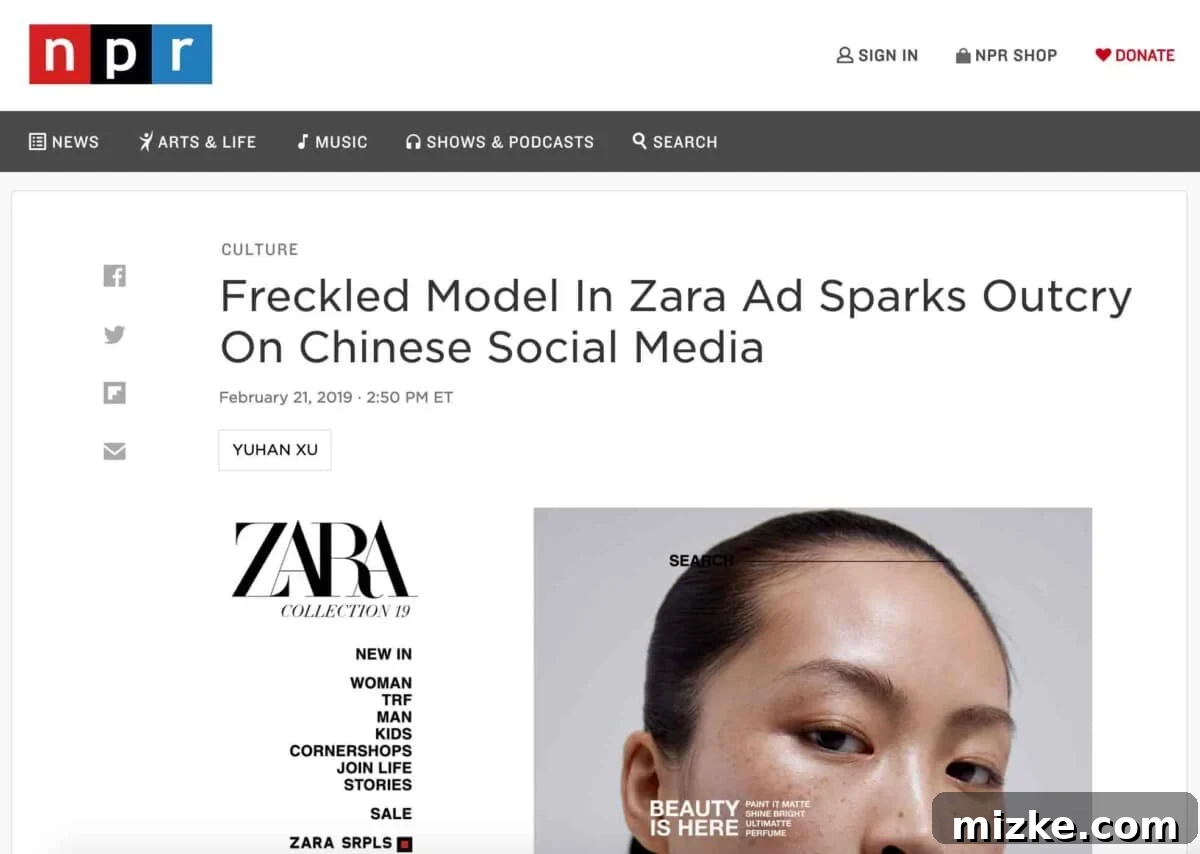
Several weeks ago, a timely article sent by Jason from NPR – ‘Freckled Model in Zara Ad Sparks Outcry on Chinese Social Media’ – immediately transported me back to the vivid memories of my childhood. The article underscored a pervasive truth: within many Asian cultures, freckles are often perceived as signs of imperfection, even ugliness. They are considered a flaw, a deviation from the ideal of flawless, fair skin, directly impacting body image and self-perception.
The pursuit of perfect skin in Asian cultures is deeply entrenched in historical and societal contexts. Light, fair skin has long been associated with nobility, status, and an indoor lifestyle, contrasting sharply with the sun-darkened complexions of those engaged in manual labor. This cultural ideal manifests in various practices: women commonly use skin-whitening products, meticulously avoid sun exposure with umbrellas and protective clothing, and rely heavily on concealers to mask any perceived imperfections. The standard of beauty is clear: unblemished, luminous skin, untouched by the sun’s kiss or the playful scattering of freckles, highlighting a significant difference in global beauty standards.
In stark contrast, Western beauty standards often embrace the opposite. Here, a sun-kissed glow and the natural charm of freckles are frequently celebrated. Tanning is a popular pursuit, and freckles are not only accepted but often cherished as unique, individualistic features. This divergence created a perplexing reality for me, an Asian individual growing up with Asian parents in a Western society. All I knew, all I absorbed, were the beauty ideals of my heritage, making the Western embrace of freckles a truly alien concept and fueling my internal conflict regarding natural beauty.
This cultural dichotomy became acutely evident whenever someone, usually non-Asian, would compliment my freckles. Phrases like “You’re so cute!” or “I love your freckles!” would genuinely take me aback. My automatic response was often a bewildered “Really?!” accompanied by a facial expression that conveyed genuine surprise, even mild disbelief, that anyone could find freckles appealing. I simply couldn’t internalize these compliments because, in my deeply ingrained perception, my face was fundamentally flawed. The thought of accepting praise for something I actively disliked was impossible given my deep-seated insecurities.
While I don’t attribute blame to my parents for instilling these beliefs – they, too, were products of their own cultural upbringing and the beauty norms they inherited – the undeniable consequence was that I developed an extremely low sense of self-esteem. It’s ironic, almost comically so, that freckles are primarily a genetic trait. There was truly nothing I could do to prevent them; I didn’t ask for them. Yet, the sheer volume of discussion and critique surrounding them throughout my formative years felt utterly nonsensical, deepening my struggle with self-acceptance and highlighting the arbitrary nature of some beauty judgments.

The Profound Impact of Words: A Personal Journey Towards Self-Worth
This reflection is not an invitation for compliments or a commentary on my physical appearance. Rather, it serves as an earnest testament to the profound and lasting impact words can have on an individual, particularly during the tender and impressionable years of childhood. Children, much like sponges, absorb far more than adults often realize. Every comment, every critique, every seemingly casual remark has the potential to seep deep into their psyches, shaping their self-image and self-worth in ways that may not be immediately apparent, directly influencing their personal journey of self-acceptance.
I often wonder if my parents truly grasp the enduring effect their consistent observations about my freckles had on me. The reality is, it left a significant mark. Even today, despite having come a long way, there are still “bad days.” Days when I find myself questioning what life would be like without my freckles, or contemplating whether a heavier layer of concealer could simply erase them from view. The echoes of those childhood critiques occasionally resurface, reminding me of the long shadow they cast. In fact, my mother recently commented that my freckles appeared darker, attributing it to dry skin – a clear indication that for her, and perhaps for me subconsciously, it remains a perceived “issue,” even as I strive for inner peace.
However, I can genuinely say that the intensity of this internal struggle has significantly diminished over time. While a lingering annoyance might surface occasionally – a fleeting thought of “why are my freckles such a big deal, anyway?” – it no longer consumes me. The shift in my perspective, particularly between my college years and the present, has been transformative. It was during this period that I underwent a profound gain in confidence, a journey that began, perhaps unexpectedly, with external validation.
I recognize that this might sound unconventional or even superficial, but for someone who had harbored such deeply rooted low self-esteem, it was a crucial catalyst. To genuinely believe I was ugly, that no one could ever find me attractive or desire to be with me, was a heavy burden. Having a boyfriend tell me I was pretty, experiencing the attention of other boys in college – these moments, initially, served as external affirmations that began to chip away at my core belief of unattractiveness. They didn’t instantly resolve my insecurities, but they provided a vital counter-narrative, offering a glimpse of a different self, one that could be seen as beautiful and paving the way for true self-love and empowerment.

From External Validation to Internal Peace: The Embrace of True Self-Love
Today, I stand in a far more peaceful and self-assured place than I ever thought possible. The relentless battle against my freckles has subsided, replaced by a quiet acceptance. I have, at long last, made peace with my freckles and, more importantly, accepted who I am as a whole person, flaws and all. This isn’t just about my skin; it’s about the broader journey of embracing my authentic self, recognizing that my worth is not dictated by external appearances or fleeting beauty standards. This profound shift signifies a true embrace of natural beauty and personal confidence.
My profound hope for this generation, especially within the powerful movement of women’s empowerment, is that we collectively commit to doing just that. Let us intentionally shift our focus away from superficial judgments about how someone looks, moving beyond outdated beauty standards. Instead, let us champion and celebrate what truly defines an individual: their character, their unwavering drive, their boundless ambition, and the depth of their heart. True empowerment lies not in conforming to narrow beauty ideals, but in recognizing and nurturing the intrinsic qualities that make each person uniquely valuable and beautiful, from the inside out. By focusing on these deeper attributes, we can foster a culture of genuine self-acceptance and respect for the diverse forms of beauty that exist in the world.